The real owner
Through holding companies and offshore layers, down to the person.
An investigative desk for Georgian corporate records — with the evidence attached.
Type a 9-digit code. The desk works fourteen Georgian registers, pulls a company’s whole registry file — every application, decision and scan — and reads it into one graph: the owners behind the owners, the liens, and whether any of them is sanctioned, politically exposed, or two steps from someone who is.
Banks, microfinance institutions and insurers must name a beneficial owner before they onboard a company. Today that answer is assembled by hand, one registry at a time, and filed as a screenshot. Here, it is one search and a dated file that cites where every line came from.
9 digits, or the company name in Georgian or English.
4 layers of ownership outward, drawn on one screen.
A dated PDF that cites its source for every claim in it.
Through holding companies and offshore layers, down to the person.
The company, its owners, and anyone within reach of them.
Declared assets and interests, and the family around them.
What the company won from the state, and who it has been to court with.
An analyst opens the registry, the procurement portal, the sanctions lists and the court records one at a time, copies what each says into a document, and attaches screenshots. Nothing joins the four.
Checking a name against a list answers whether the company is listed. It cannot answer whether the person who controls it is two steps from someone who is. That is the case the rules were written for.
One code. The ownership network around it, drawn. A dated file naming the record behind every line, and a ledger entry saying who asked and when.
Georgian anti-money-laundering law requires every bank, microfinance institution and insurer to identify the person who ultimately owns a corporate customer: anyone holding 25% or more of the shares or votes, directly or through someone else.
What the EU accession track changes is not whether that work is required. It is how much of it has to be provable afterwards.
Law of Georgia on Facilitating the Prevention of Money Laundering and the Financing of Terrorism, Article 13. The institutions named above are accountable persons under Article 3.
The institutions under that obligation can be counted, because their supervisors publish the registers: 17 licensed commercial banks, 2 microbanks and 28 microfinance organisations under the National Bank, and 19 licensed insurers. 66 institutions, and each one is a licence.
National Bank of Georgia, registers of licensed commercial banks, licensed microbanks and registered microfinance organisations; Insurance State Supervision Service of Georgia, licensed insurers. Read 19 August 2026.
81,225 companies are active on the Georgian register. Every one of them is a counterparty somebody has to name an owner for.
National Statistics Office of Georgia, business register, active commercial legal persons, 1 July 2026.
The work recurs. The owner must be identified when a corporate customer is taken on and verified again on a schedule set by risk — so the companies above are not screened once. They are screened for as long as anyone banks them.
None of this is peculiar to Georgia. Every state on the EU accession track is adopting the same directive shape — the same ownership threshold, the same obliged institutions — and the work this system proves in one such country is the work that shape requires in all of them.
Every screening ends in one artifact: a dated file that names its subject, draws the ownership network, and cites a source for every line in it. It is what goes into the customer file, and what an inspector is handed.
Or read one produced already: the same engine, run over the demonstration corpus of invented companies, in the language the file will be read in.
Produce one now: run a search on this instance and export the file.
Not every reader needs a licence. A law firm with one matter, an auditor with a season of engagements, a person checking a partner before signing — choose how many subjects, and what arrives is the file shown above: cited, dated, in your language.
| Dossiers | Each |
|---|---|
| 1–9 | GEL 95 |
| 10–49 | GEL 75 |
| 50–99 | GEL 60 |
| 100+ | GEL 45 |
The price is anchored, not plucked: the one public price for an investigated report on a Georgian company is €480 with ten days of delivery; a single machine-compiled company report retails at $139.99; the bare registry extract alone costs GEL 13–39 by the official fee schedule. A GeoShield dossier compiles fourteen registers, cited, typically within one working day. The card is typed on Stripe’s page — no payment details pass through this one.
Five screens from this same build, serving the demonstration corpus — seven invented companies and four invented people, so no real subject appears. Select any screen to enlarge it.
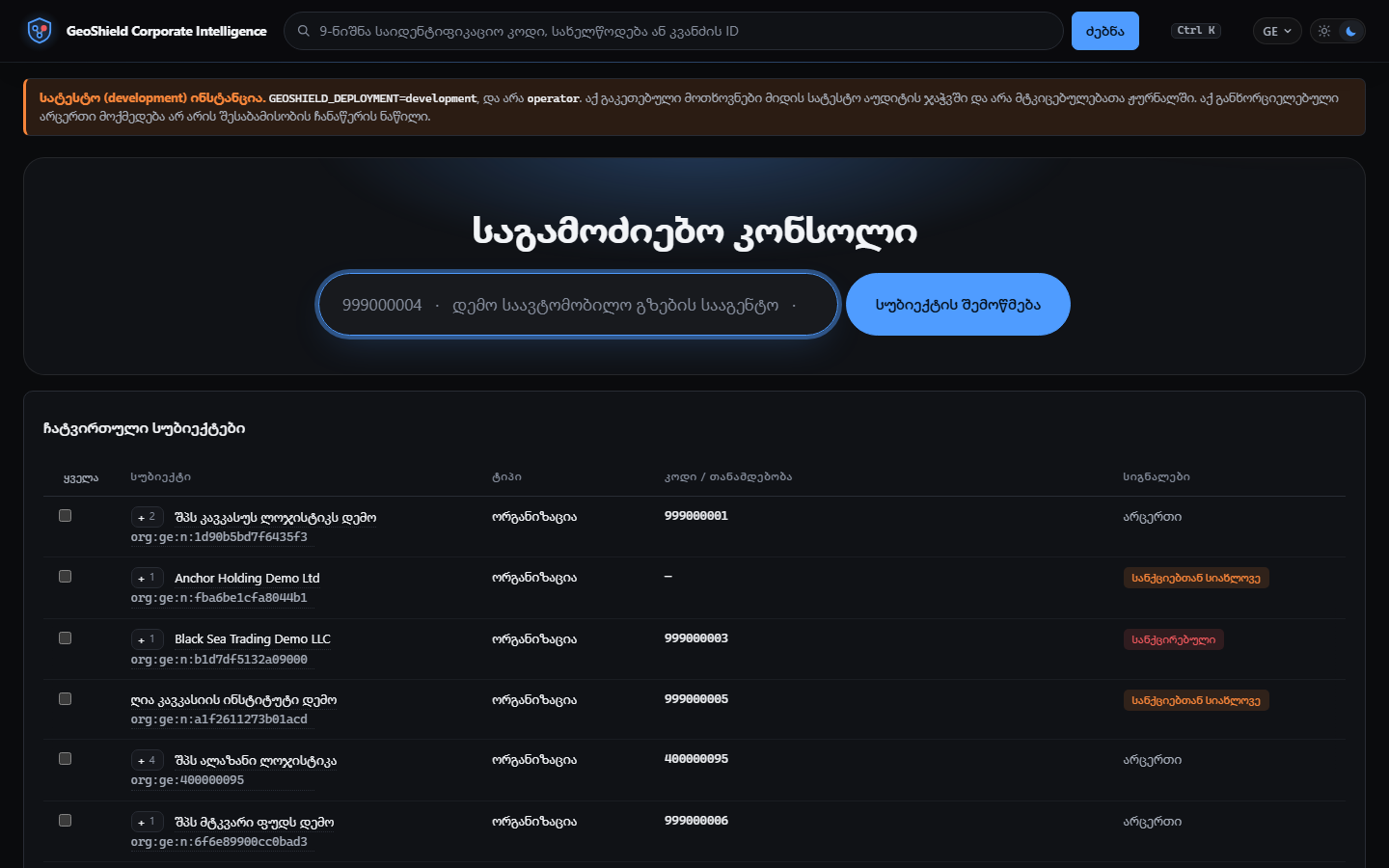
The console. A subject is found by identification code, legal name in either alphabet, or node id — and the counts under the search are read from the loaded graph.
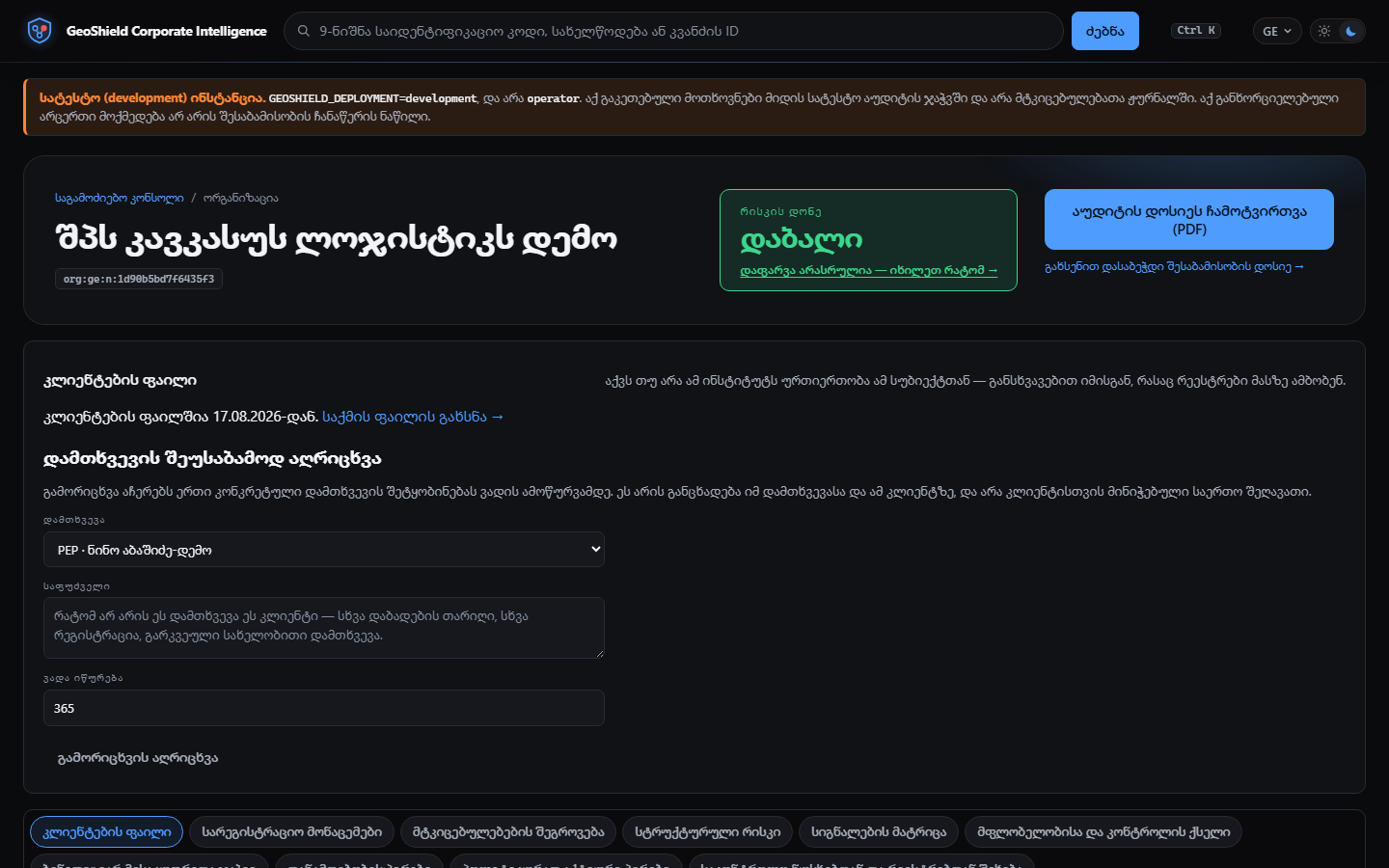
A screened subject. The risk band, the confidence beside it and the source coverage it rests on, with the dossier export one press away.
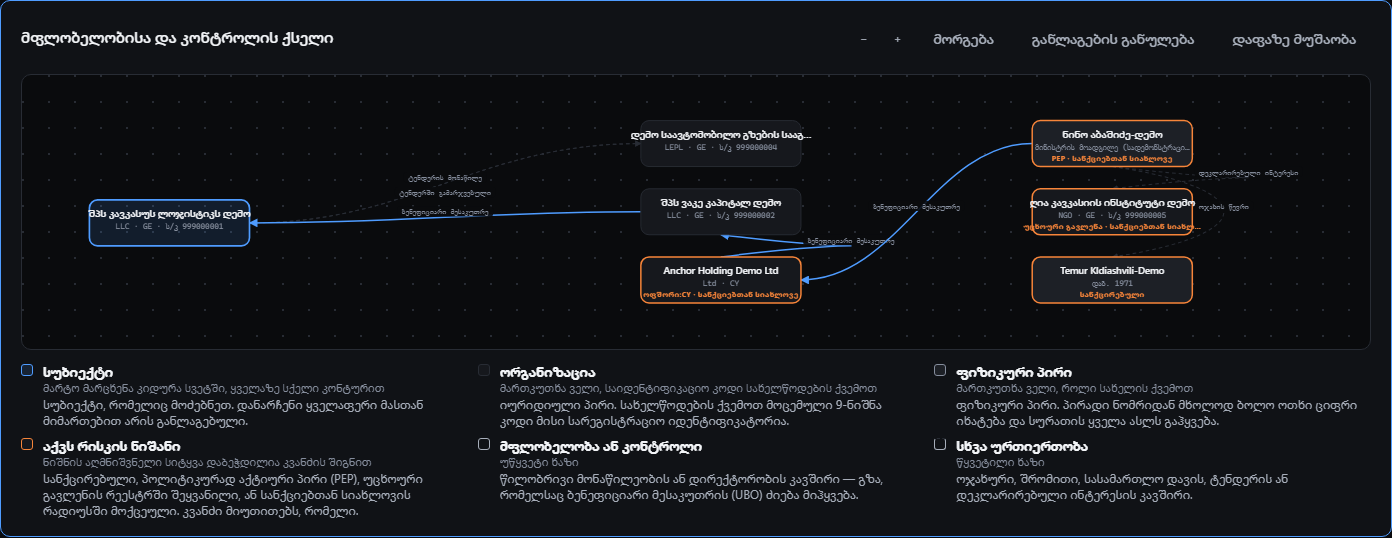
The ownership and control network, laid out by hop distance from the subject — the sanctioned parties and the offshore layer flagged in the same palette every page uses.
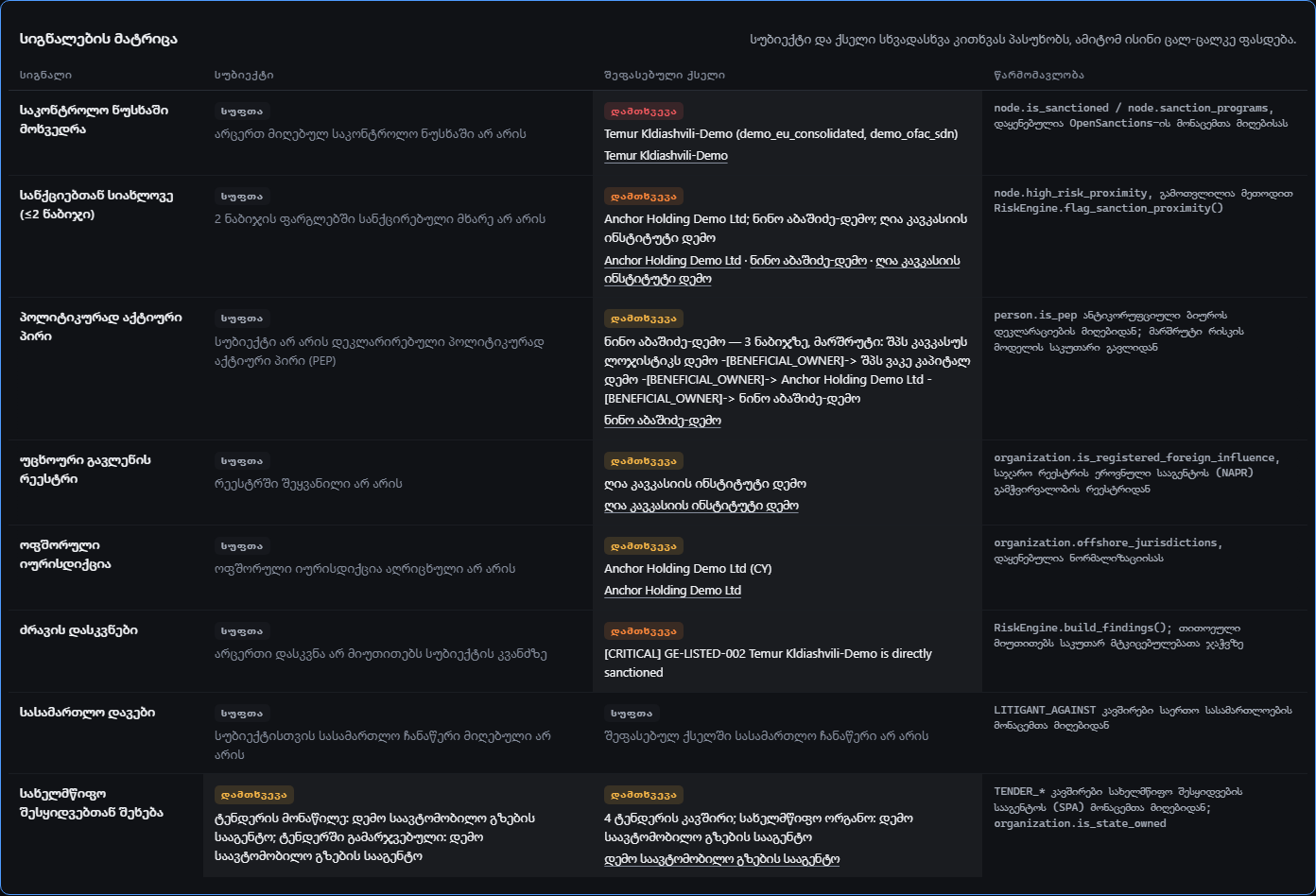
Engine findings. Each names its severity and score and prints the evidence chain behind it, cited to the registry record it came from.
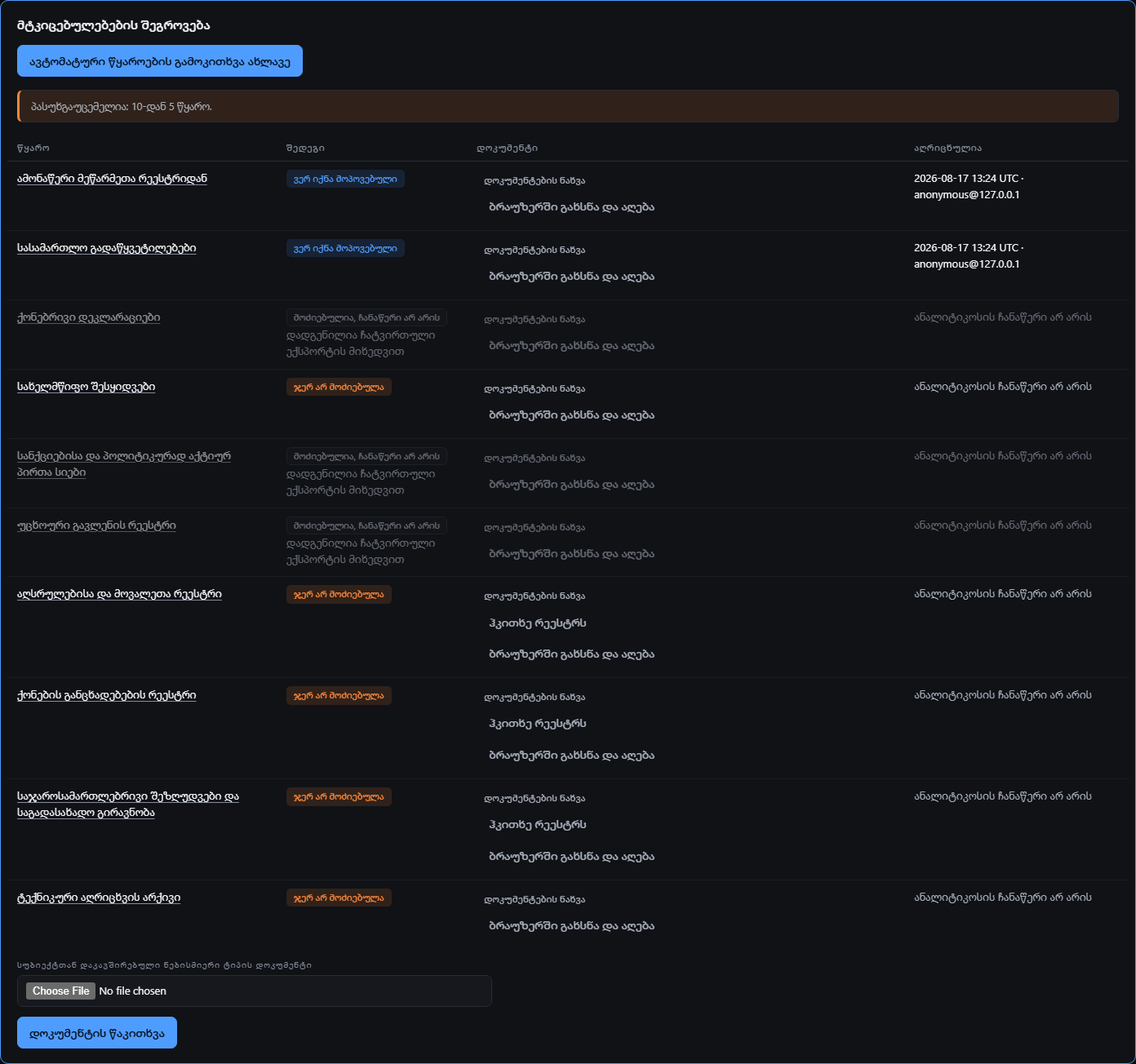
Evidence collection. One row per register, each answered or carrying the reason it could not be: the three that answer a query are asked from here, and the rest open in a browser window with the subject already typed in.
GeoShield is opening to a first group of institutions. What the first group gets: a pilot running beside the process you use today, on your own hardware, a direct line to the person who built the system, and a say in what it becomes next.
Everything above this line was measured on the instance serving you this page — the same build an early-access institution installs. The pilot adds your registry access and your own book, and takes nothing off your network.
Every lookup appends to a hash-chained ledger that can be sealed and exported. A competitor can re-collect the registries; nobody can reconstruct last year’s evidence trail after the fact.
World-Check, Orbis and their kind answer one question: is this name on a list. None of them holds the Georgian registry’s ownership graph joined to state contracts and court records — so a sanctioned party two steps out through an offshore parent, the finding at the top of this page, is not a query they can run.
While any source is still outstanding, recording a determination is refused and the missing ones are named. Software that lets an officer approve over an incomplete file is exactly what an inspection looks for.
Six of the fourteen answer a machine — three the pipeline ingests whole, and three the desk questions one subject at a time. The rest answer a CAPTCHA, a Disallow: or a sign-in, so an analyst works them by hand in a window this portal opens with the subject already typed in. The extract they save and the ruling they download become records in this graph, cited to the document. What could not be got carries its reason instead of a gap that reads like a clean result.
This instance is published for demonstration, so it serves you and not only its own machine. What ships to a customer is this same build behind your own network. The graph stays on your hardware, the portal loads nothing from any outside server, and the search on this page posts to this same portal and nowhere else.
python run_sandbox.py. No real person is in it.0600 file, never a command line, never a log.Personal data is handled for the accountability Georgian law expects: pseudonymised identifiers in the logs, personal numbers masked on screen, one ledger entry per lookup. Whether a given deployment is compliant is your data protection officer’s finding to make, not this page’s.
GeoShield is sold as an annual licence to the institution: one deployment inside your network, renewed by the year. Ask for the price when you reach out for access — it is quoted in that conversation, against your institution’s own screening volume.
A pilot points this at the registry access you already have and runs beside the process you use today, on your hardware. What comes back is the same dated file, for subjects you can check yourself.
Reading this as an investor rather than a compliance officer? The same person answers — and the numbers you would diligence are printed above, each with its source.
Giorgi Gusharashvili · Founder, GeoShield · The founder’s record